Medicare Made Simple
By James Kaufer
What Medicare covers, what it doesn't, and what you should understand before choosing your coverage.
You Have Medicare. Now What?
Getting your Medicare card is an important step. But it isn't the end of the Medicare decision. In many ways, it's the beginning.
Medicare provides valuable healthcare coverage, but Medicare does not simply pay every medical expense you may have.
There are premiums, deductibles, copays and coinsurance to understand. Original Medicare generally doesn't cover most outpatient prescription drugs. Routine dental, vision and hearing care generally aren't covered by Original Medicare. And Original Medicare by itself doesn't put a yearly limit on what you could spend out of pocket for covered Part A and Part B services.
That's why you hear so much about Medicare Advantage, Medicare Supplement insurance and Part D prescription drug plans.
My goal with this guide is not to convince you that Medicare Advantage is better or that Medicare Supplement insurance is better. There is no single Medicare solution that's right for everybody.
My goal is to help you understand what Medicare actually provides, where your financial exposure can come from, why people add additional coverage, how Medicare Advantage and Medicare Supplement differ, how prescription coverage works, what advertised extra benefits really mean, when enrollment timing matters, and what questions you should ask before choosing coverage.
“The purpose of insurance is simple: reduce your risk, limit your liability, and protect you from financial exposure.”
The cheapest premium isn't always the cheapest healthcare. The biggest dental allowance isn't automatically the best dental coverage. The plan with the longest list of benefits isn't automatically the best medical coverage. And the coverage that's perfect for your neighbor may be completely wrong for you.
Before comparing plans, understand the problem you're trying to solve.
1. Start With Original Medicare
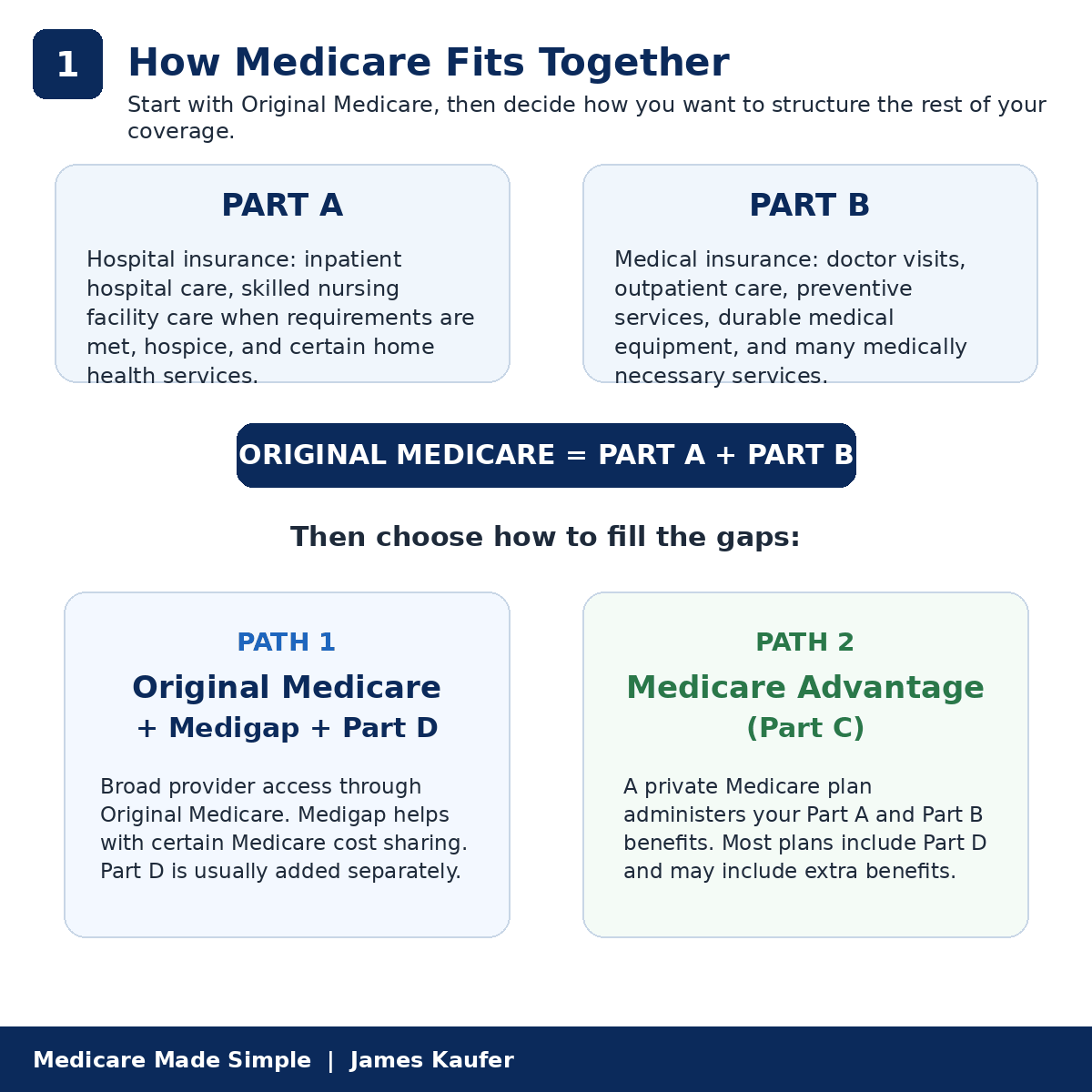
Medicare Part A helps cover inpatient hospital care, skilled nursing facility care when Medicare's requirements are met, hospice care, and certain home health services.
Most people don't pay a monthly Part A premium because they or their spouse paid Medicare taxes long enough while working.
For 2026, the Part A inpatient hospital deductible is $1,736 per benefit period. A benefit period is not the same as a calendar year, and more than one benefit period can occur in a year.
Medicare Part B helps cover doctor visits, specialist services, outpatient care, preventive services, durable medical equipment, ambulance services when Medicare requirements are met, and many medically necessary tests, treatments and procedures.
For 2026, the standard Part B premium is $202.90 per month, although higher-income beneficiaries may pay more. The 2026 Part B deductible is $283.
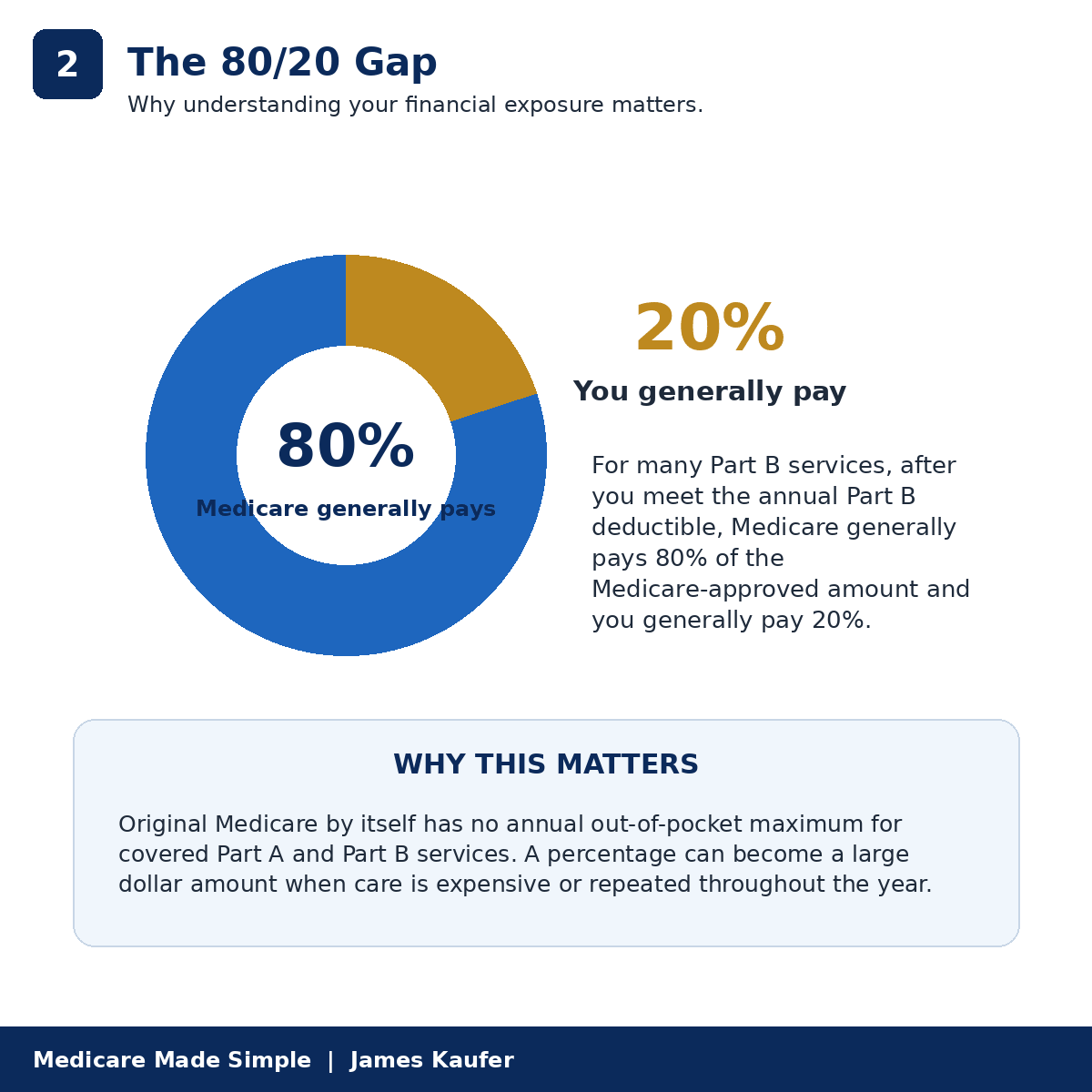
After the deductible, for many Part B-covered services under Original Medicare, you generally pay 20% of the Medicare-approved amount.
2. Medicare Covers More Than Sick Care
Part B covers many preventive services when Medicare's requirements are met, including numerous screenings, vaccines, preventive counseling services, Annual Wellness Visits, and the one-time “Welcome to Medicare” preventive visit for eligible people during the first 12 months they have Part B.
3. Where Your Financial Exposure Remains
For many Part B services, Medicare generally pays 80% of the Medicare-approved amount after the applicable deductible and you generally pay 20%.
Original Medicare by itself has no annual out-of-pocket maximum for covered Part A and Part B services.
That's why you should ask both: “What will my coverage cost every month?” and “What could my coverage cost me when I actually need healthcare?”
4. Why People Add Coverage
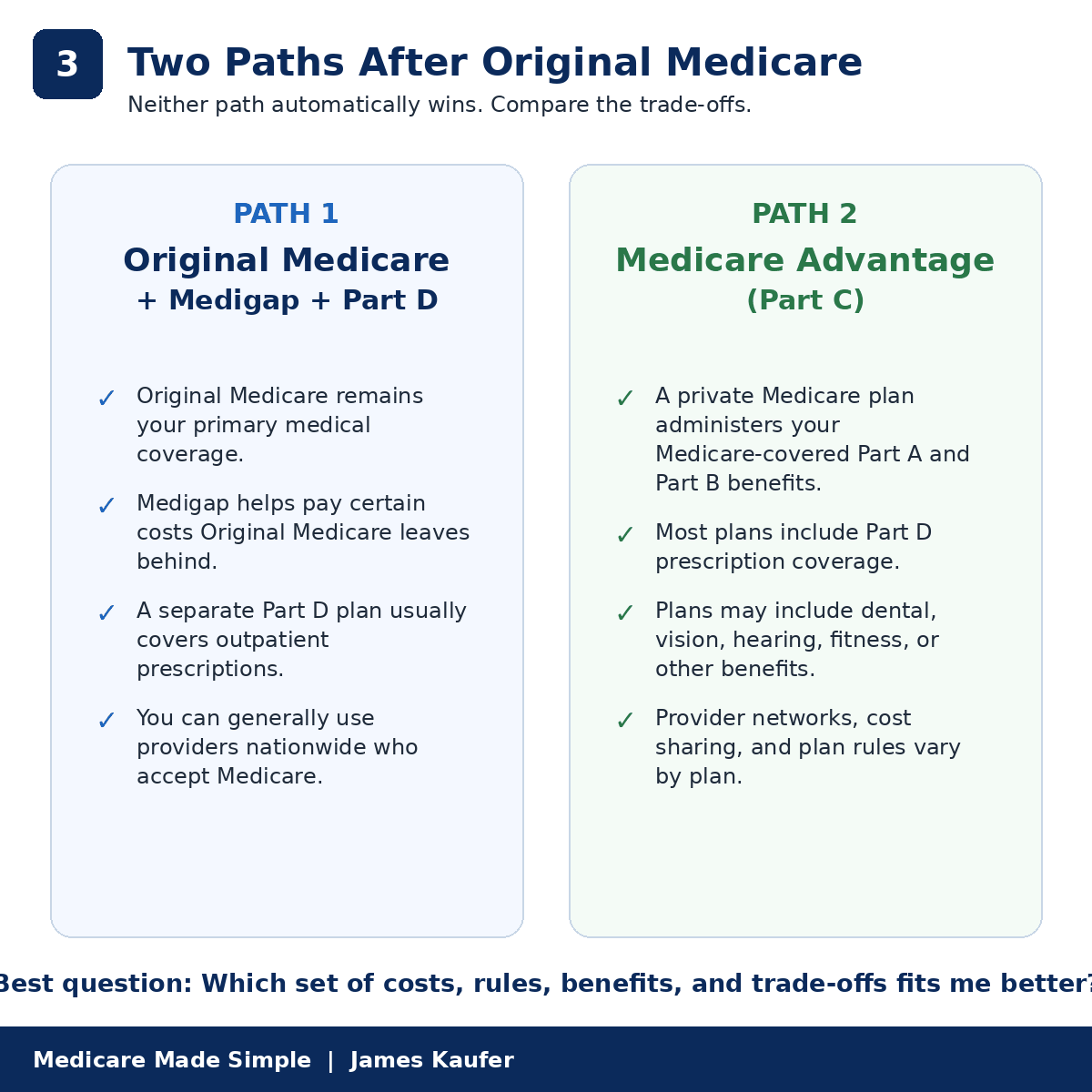
Path One: Original Medicare + Medigap + Part D.
Path Two: Medicare Advantage.
Neither path automatically wins. The better question is: Which set of costs, rules, benefits and trade-offs fits my situation better?
5. Understanding Medicare Advantage
Medicare Advantage plans can use provider networks. With an HMO, non-emergency care generally stays within the plan's network, subject to plan rules. A PPO generally provides more flexibility, but out-of-network costs may be higher.
“My doctor takes Medicare” is not the same as “My doctor participates in this Medicare Advantage plan.”
Medicare Advantage plans can establish copays, coinsurance and deductibles for covered services within Medicare's rules.
Medicare Advantage plans have an annual maximum out-of-pocket limit for covered Part A and Part B services. This medical maximum does not mean every healthcare expense — including premiums, Part D prescription costs, or non-covered services — counts toward that limit.
Plans may require prior authorization for certain services, procedures, equipment or supplies.
Some plans have a $0 additional monthly plan premium. You generally still pay your Medicare Part B premium and can have other healthcare costs.
Plans may offer dental, vision, hearing, fitness, transportation, over-the-counter and other benefits. Those benefits can have value, but they should not replace evaluation of the medical and prescription coverage.
6. Understanding Medicare Supplement Insurance
With Medigap, you remain in Original Medicare. Original Medicare processes Medicare-covered healthcare and the Medigap policy helps pay certain amounts Original Medicare leaves as your responsibility.
With Original Medicare, you can generally use any doctor or hospital in the United States that accepts Medicare.
In most states, Medigap policies are standardized by plan letter. A Plan G from one company provides the same standardized medical benefits as a Plan G from another, although premiums, pricing methods, customer service, company history and future rate increases can differ.
Plan G is one of the more comprehensive options available to people newly eligible for Medicare. Plan N may have a lower premium in some markets but includes certain additional out-of-pocket costs and does not cover Part B excess charges.
Medigap policies sold today generally do not include outpatient prescription drug coverage, so a separate Part D plan is usually considered.
7. Medigap Open Enrollment and Trial Rights
Your federal Medigap Open Enrollment Period generally lasts six months beginning when you are 65 or older and enrolled in Part B. It is not the same as the October 15–December 7 Medicare Open Enrollment Period.
Outside your Medigap Open Enrollment Period, unless you qualify for a guaranteed-issue right or another protection, medical underwriting may apply depending on the circumstances and state law.
Federal law also provides certain Medigap Trial Rights in specific situations, including some first-time Medicare Advantage situations. These rights are circumstance-specific and should not be read as a promise that someone can always return to any Medigap policy they want later.
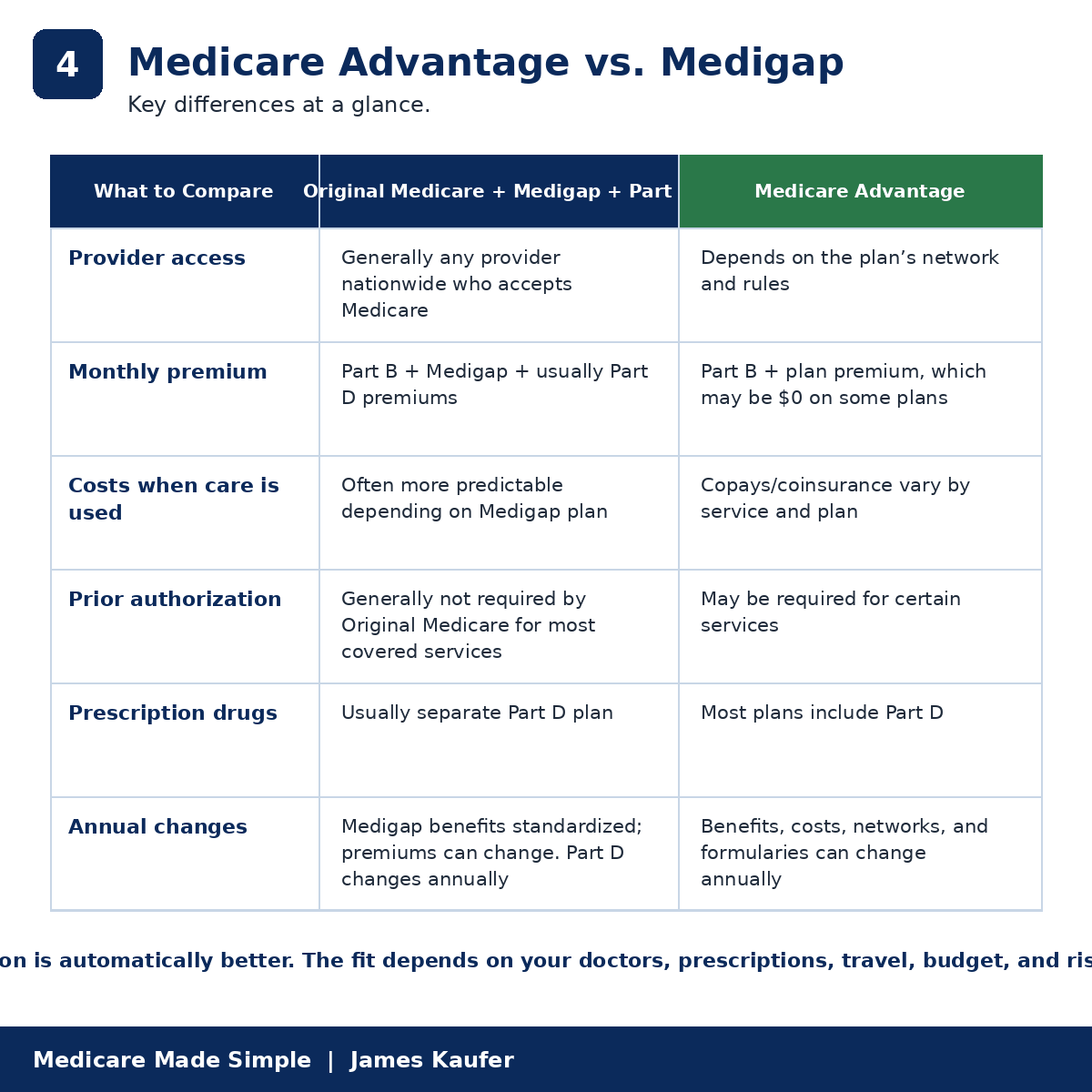
8. Compare the Trade-Offs
Compare provider access, monthly premium, costs when care is used, prescription structure, prior authorization, additional benefits, annual plan changes, travel, and overall financial exposure.
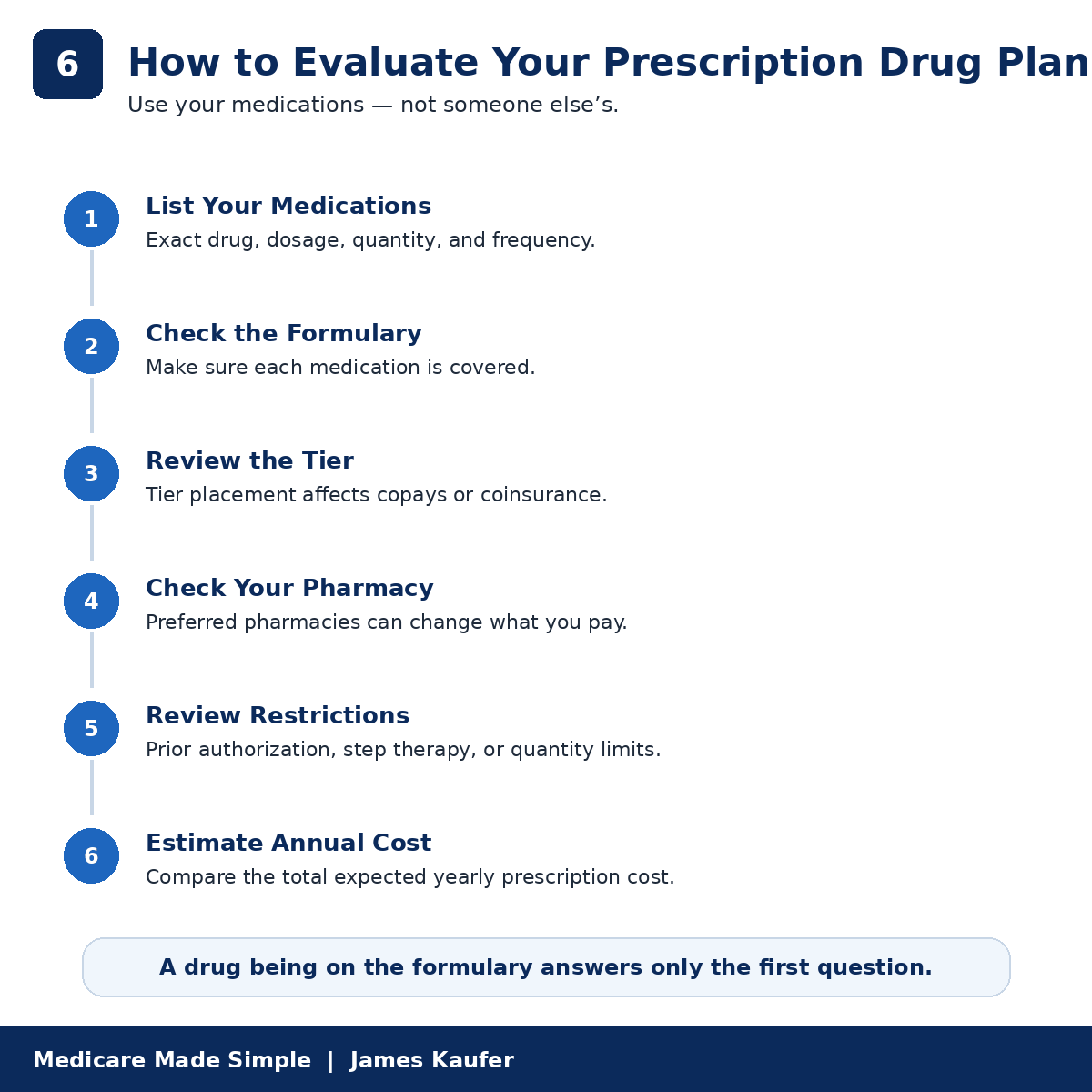
9. Prescription Drugs Deserve Their Own Decision
Do not ask only, “Does the plan include drug coverage?” Ask, “How does this plan cover my drugs?”
Check the formulary, tier, pharmacy, deductible, copay or coinsurance, prior authorization, step therapy, quantity limits and expected annual cost.
For 2026, out-of-pocket spending on covered Part D drugs is capped at $2,100 for the calendar year. The maximum Part D deductible for 2026 is $615, although an individual plan can have a lower deductible or no deductible.
The Medicare Prescription Payment Plan can spread eligible out-of-pocket prescription costs across the calendar year. It changes when you pay; it does not reduce the total amount you owe.
10. Read Past the Dental Headline
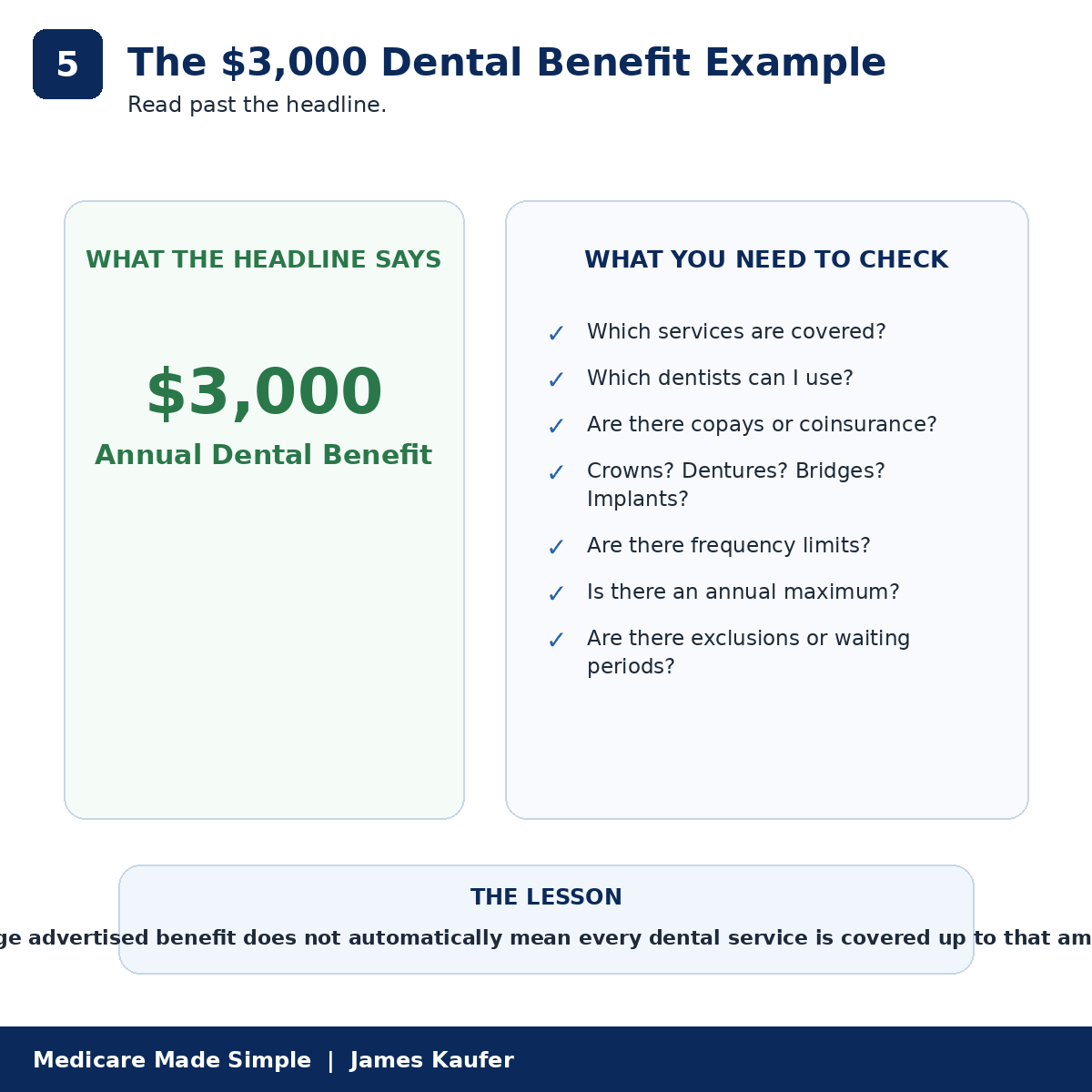
A $3,000 dental benefit does not necessarily mean the plan will pay $3,000 toward any dental treatment you choose.
Check covered services, network rules, copays or coinsurance, crowns, dentures, bridges, implants, frequency limits, annual maximums, waiting periods and exclusions.
Read the benefit — not just the number.
11. What Happens During a Bad Health Year?
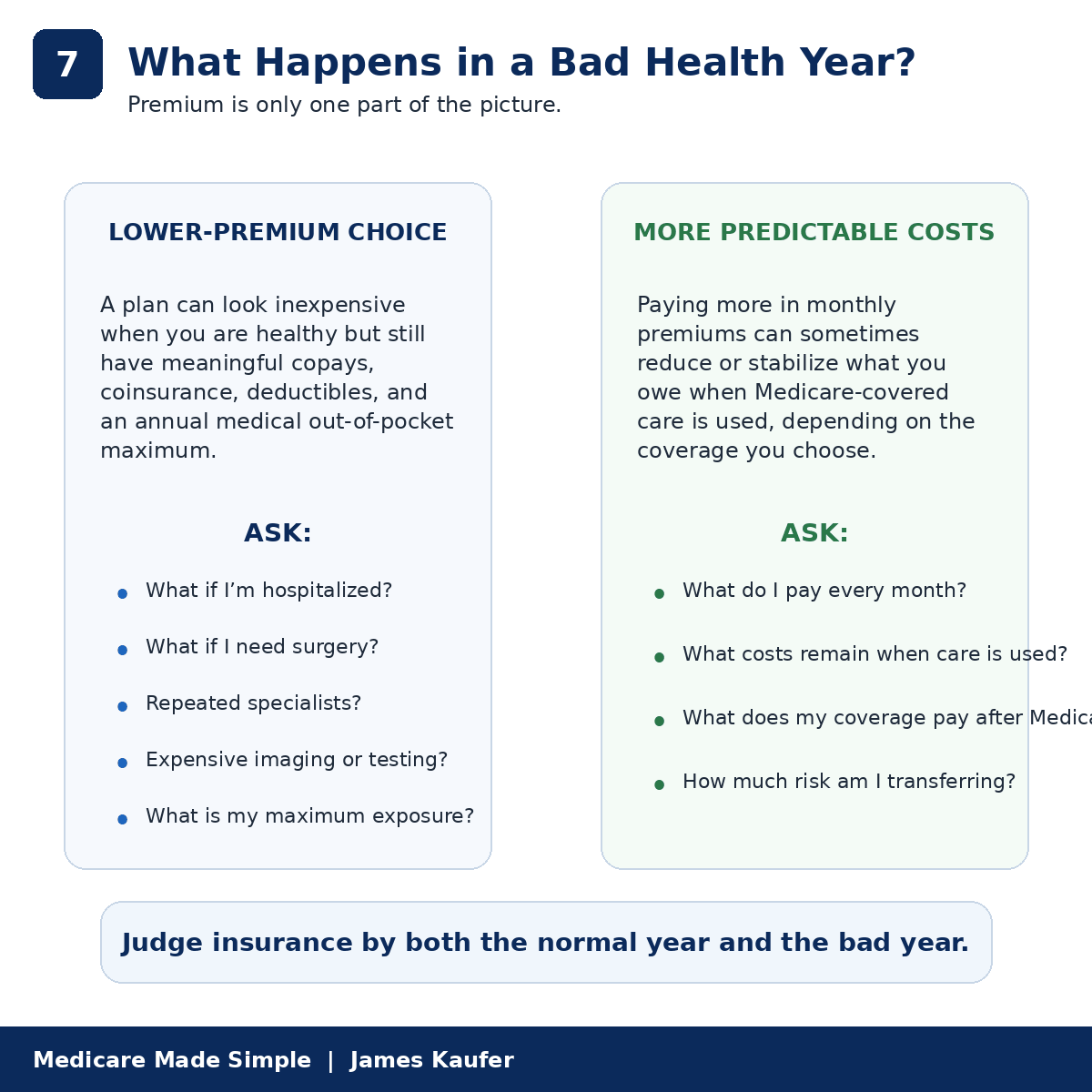
Do not evaluate insurance only from the perspective of a healthy year. Ask what happens if you need repeated specialist care, outpatient surgery, expensive imaging, hospitalization or costly prescriptions.
Judge both the normal year and the bad year.
12. Travel and Provider Access
Original Medicare generally allows Medicare-covered care from providers throughout the United States who accept Medicare.
Medicare Advantage plans have their own network and service-area rules. Emergency and urgently needed care have specific protections, but routine non-emergency care away from the plan's network or service area depends on the plan.
Original Medicare generally provides very limited coverage outside the United States except in specific circumstances. Some Medigap plans include limited foreign-travel emergency benefits, and some Medicare Advantage plans may offer emergency or urgent coverage outside the country.
13. Still Working at 65?
Turning 65 does not automatically mean everyone should immediately enroll in every part of Medicare.
Active employment, employer size, employer coverage, spouse coverage, creditable drug coverage, HSA contributions and retirement timing can all matter.
Do not assume COBRA, retiree coverage or simply having insurance gives you the same Medicare enrollment protections as active-employment coverage.
14. Timing Can Cost You
Part B late-enrollment penalties may apply if you do not enroll when first eligible and do not qualify for an applicable Special Enrollment Period. The Part B penalty is generally 10% for each full 12-month period you could have had Part B but did not enroll.
A Part D late-enrollment penalty may apply after 63 consecutive days or more without Part D or other creditable prescription drug coverage after you are eligible.
15. HSA Considerations
Once enrolled in Medicare, you generally can no longer contribute to an HSA. For people enrolling after 65, Part A can sometimes be retroactive, which can create tax issues if HSA contributions continued during months later covered by Medicare.
16. Enrollment Periods
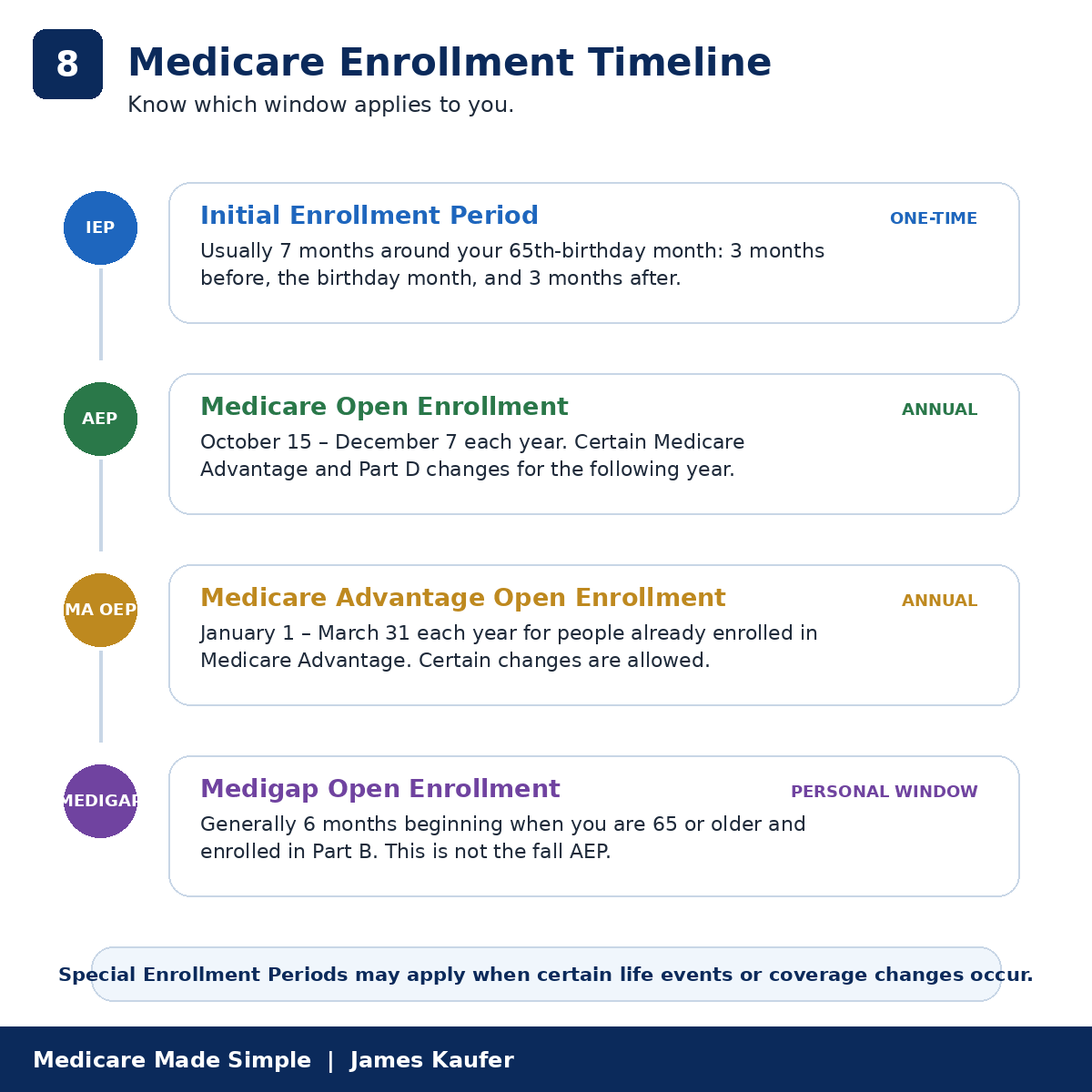
Initial Enrollment Period: usually seven months around your 65th-birthday month.
Medicare Open Enrollment: October 15 through December 7.
Medicare Advantage Open Enrollment: January 1 through March 31 for people already enrolled in Medicare Advantage.
Special Enrollment Periods: may apply when certain qualifying events occur.
Medigap Open Enrollment: generally six months beginning when you are 65 or older and enrolled in Part B.
17. IRMAA
Higher-income beneficiaries may pay an Income-Related Monthly Adjustment Amount for Part B and Part D. Social Security generally uses tax information from two years earlier. Certain life-changing events may allow reconsideration.
18. Extra Help and Medicare Savings Programs
Extra Help can reduce certain Part D costs for qualifying people with limited income and resources.
Medicare Savings Programs are state-administered programs that can help qualifying individuals with certain Medicare costs.
Do not automatically assume you will not qualify.
19. Special Needs Plans
D-SNPs are designed for certain people with both Medicare and Medicaid.
C-SNPs are designed for people with certain severe or disabling chronic conditions.
I-SNPs are designed for certain people who need an institutional level of care.
Eligibility and plan availability vary.
20. Your Plan Can Change — And Your Life Can Change
Your doctor can leave a network. Your prescriptions can change. Your health can change. Your plan can change. Your priorities can change.
Read your Annual Notice of Change.
A review does not mean you need to switch. Sometimes the correct conclusion is: Keep exactly what you have.
Go Deeper
Two useful references — tap to expand.
21. Ten Questions Before Choosing Coverage
- Are my doctors available?
- Are my preferred hospitals and health systems available?
- How are my actual prescriptions covered?
- What could I realistically spend during a bad health year?
- What is my maximum financial exposure?
- Do I travel frequently or live elsewhere part of the year?
- How important is predictable monthly spending?
- Am I comfortable with network and prior-authorization requirements when they apply?
- Which additional benefits would I actually use?
- Am I evaluating the entire coverage package or reacting to one attractive feature?
22. Medicare Decision Checklist
Gather your Part A and Part B effective dates, prescriptions and dosages, preferred pharmacy, doctors and specialists, hospitals and health systems, travel habits, employer or retiree coverage information, monthly budget, comfort with copays and variable expenses, dental/vision/hearing needs, and questions you still need answered.
So, What's the Best Medicare Coverage?
There isn't one.
Start with: “What do I need my Medicare coverage to do for me?”
Once you understand that, comparing your options becomes much easier.