Medicare Advantage or Medicare Supplement?
There isn't one answer that's right for everyone. Your budget, doctors, prescriptions, travel, healthcare needs, and the way you prefer to manage medical expenses can all affect which direction makes more sense. Answer a few questions and I'll help you understand the tradeoffs between Medicare Advantage and Medicare Supplement coverage.
Start My Medicare ComparisonNo pressure. No obligation. Just Medicare education.
This educational guide identifies which coverage structure may better match your stated preferences. It does not determine eligibility, guarantee enrollment, or recommend a specific insurance plan.
Why Do People Add Coverage to Original Medicare?
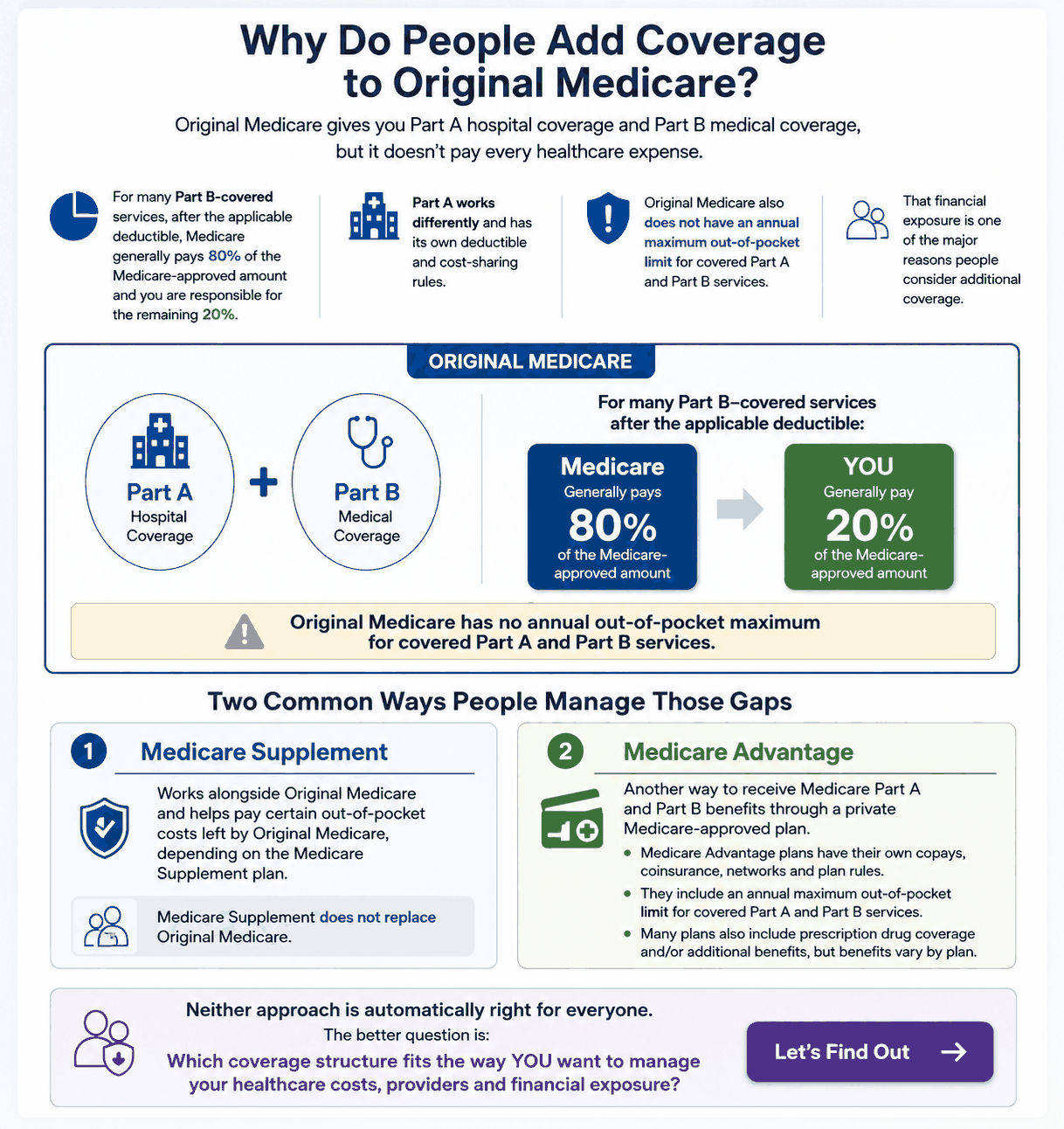
Original Medicare gives you Part A hospital coverage and Part B medical coverage, but it doesn't pay every healthcare expense.
For many Medicare Part B-covered services, after the applicable Part B deductible, Medicare generally pays 80% of the Medicare-approved amount and you are responsible for the remaining 20%.
Part A works differently and has its own deductible and cost-sharing rules.
Original Medicare also does not have an annual maximum out-of-pocket limit for covered Part A and Part B services.
That financial exposure is one of the major reasons people consider additional coverage.
What Original Medicare Covers
Original Medicare includes Part A and Part B, but it doesn't pay 100% of every covered healthcare cost.
You may still have deductibles, coinsurance, copays where applicable, and other out-of-pocket costs.
What It Doesn't Include
Original Medicare generally does not include outpatient prescription drug coverage.
Part D, or prescription drug coverage through another qualifying option, may be needed to fill that gap.
Two Common Ways to Add Coverage
Medicare Advantage is one way to receive your Medicare benefits through a private, Medicare-approved plan.
Medicare Supplement insurance is another option, designed to help cover certain costs left by Original Medicare.
What's Right Depends on You
The appropriate direction depends on your doctors, prescriptions, healthcare needs, budget, travel needs, and personal preferences.
Two Common Ways People Manage Those Gaps
1. Medicare Supplement
Works alongside Original Medicare and helps pay certain out-of-pocket costs left by Original Medicare, depending on the Medicare Supplement plan.
Medicare Supplement does not replace Original Medicare.
2. Medicare Advantage
Another way to receive Medicare Part A and Part B benefits through a private, Medicare-approved plan. Medicare Advantage plans:
- Have their own copays, coinsurance, provider networks, and plan-specific rules
- Include an annual maximum out-of-pocket limit for covered Part A and Part B services
- May include prescription drug coverage and additional benefits, but benefits vary by plan
Neither approach is automatically right for everyone.
The better question is: which coverage structure fits the way you want to manage your healthcare costs, providers, and financial exposure?
Where Are You With Medicare?
This helps me put your answers in context. It does not affect your score, but it may change some of the information shown with your result.
How important is keeping your monthly healthcare premiums down?
How would you rather handle your healthcare expenses?
How important is flexibility when choosing doctors and hospitals?
Provider Access Works Differently
With Original Medicare and a Medicare Supplement, you generally can see healthcare providers nationwide who accept Medicare.
Medicare Advantage plans operate differently. Many use provider networks. HMO plans generally place greater emphasis on receiving covered non-emergency care within the plan's network, subject to the plan's rules. PPO plans generally provide more flexibility and may cover services from out-of-network providers, although the member may pay more and plan-specific rules still apply.
Emergency and urgently needed care have separate protections and should not be presented as unavailable simply because someone is traveling.
The actual network, out-of-network benefits and costs should always be checked for the specific plan.
Do you travel frequently or spend significant time away from home?
If Medicare Advantage ends up being a good fit, which additional benefits would matter most to you?
Select as many as apply. This helps identify what to look at later — it doesn't affect your result.
What About Dental, Vision, Hearing & Other Extra Benefits?
Medicare Advantage plans can offer additional benefits that Original Medicare does not cover, but those benefits can vary significantly from one plan to another.
One plan may offer a Part B premium reduction — often called a giveback — while providing little or no dental, vision or hearing coverage. Another plan may offer no giveback but provide stronger dental, vision and hearing benefits. Other plans may fall somewhere in between.
Even the dollar amount does not always tell the whole story. A plan advertising a $2,000 or $3,000 dental benefit does not necessarily mean you can receive that amount of dental work at no cost. You still need to look at what procedures are actually covered, provider requirements, copays or coinsurance, frequency limitations, annual maximums, and how the plan treats services such as crowns, dentures or implants.
That is why Medicare coverage should not be chosen based on one attractive benefit.
"The purpose of insurance is simple: reduce your risk, limit your liability, and protect you from financial exposure."
Extra benefits can absolutely be valuable, but they should be considered as part of the entire plan — not in isolation.
Medicare Supplement policies generally do not include routine dental, vision or hearing benefits. If those benefits are important to you, separate coverage may be available for an additional premium.
How important is having your prescription drug coverage bundled with your medical coverage?
Many Medicare Advantage plans include Part D prescription drug coverage, though not every plan does. Medicare Supplement plans do not include prescription drug coverage — if you choose that route, you'll generally need to consider a separate Part D plan, and its premium and coverage should be included when comparing your total healthcare budget.
Which statement sounds most like you?
Why Your Answers Leaned This Direction
What You Still Need to Compare
Compare the Whole Picture
Don't compare Medicare Supplement vs. Medicare Advantage by looking at one premium alone.
Medicare Advantage: Medicare Advantage plan premiums vary. Depending on the plan, you may pay a plan premium in addition to your Medicare Part B premium. Medical services may also involve copays or coinsurance as healthcare is used, subject to the plan's annual maximum out-of-pocket for covered Part A and Part B services.
Medicare Supplement: An additional monthly Medigap premium in exchange for generally more predictable medical cost-sharing, depending on the Medigap plan selected. Separate Part D coverage is generally needed, and dental, vision, and hearing coverage may require separate coverage and an additional premium.
Regardless of which direction you lean, you'll generally continue paying your Medicare Part B premium either way.
"The purpose of insurance is simple: reduce your risk, limit your liability, and protect you from financial exposure."
The right Medicare choice isn't simply the option with the most benefits or the lowest premium. It's the coverage structure that makes sense for your budget, doctors, prescriptions, and priorities.
Ready to Look at Your Actual Medicare Options?
Your result is a starting point — not a plan recommendation. The next step is looking at your doctors, prescriptions, budget, priorities, and the Medicare options available where you live.
I can sit down with you one-on-one and help you compare your options so you can make an informed decision.
This educational guide is designed to help you understand some of the differences between Medicare Advantage and Medicare Supplement coverage. It does not determine which plan or type of coverage is right for you. Plan availability, benefits, costs, provider networks, formularies, and eligibility can vary.